26 September 2008

Cagematch: Tropical Thunder v Burn After Reading

Cagematch, Cinema: Burn After Reading vs Tropic Thunder

It has been a while since I have done the theatrical Cagematch, so please forgive the error I am about to make: referring to the same source for the reviews.

Tropic Thunder is destined to lose most of the Cagematches it which it finds itself. While Dustin Rowles has a nice review of the movie over Pajiba, Rowles is plagued by a single fault: courtesy. His review is scathing in places but then not in others that richly deserve it. His one bit of deserved praise is solely about Robert Downey, Jr’s performance:

Robert Downey, Jr. owns Tropic Thunder. A dude playing a dude disguised as another dude steals just about every second within every minute of every scene he is in. Even when he’s given mediocre material to work with, he transcends it while firmly maintaining a supporting role, so the shtick blessedly doesn’t get old and, assuming there’s not an unnecessary sequel, you can find comfort in the knowledge that Downey has created one of the great characters in comedic history (and there is no one, I’d argue, that could’ve come close to pulling it off as well as Downey — anybody else and it would’ve been laughable, over-the-top, and offensive, instead of silly, ridiculous and, in its implicit commentary on the hubris of white America and the egotism of actors, pretty insightful too).
Other than that section Rowles is undeservedly nice to the movie. Rowles is incorrect when he claims this movie is not about men in states of arrested development. While this is true of some parts of the movie, overall it is about a state of arrested development. What Rowles misses (how does he miss this?) is that it is about an industry run by adolescents, so no local criticism is made of the characters being adolescents. Rowles says the problem with the movie is that they “created a brilliant comedic premise, offered up all the raw materials for a great Hollywood satire, and then half-assed it.” Of course they did. The industry attracts half-assers firstly because of the (as Rowles notes) bottom-line directives but also because it is the half-assers which are more concerned with celebrity and “making art” than making serious criticism. I realize there are exceptions to the rule and you are welcome to name them but I would argue they are the exceptions that prove the rule.

A movie that is a better criticism of adolescents is Burn After Reading. When watching the other movies by the Coens I realize they are mocking morons, but I never actually feel as though they endorse those in power because they usually do a fine job of also lampooning those with money and/or power. However, this movie is different.

Malcovich’s monologue at the very end resonates. Normally I feel these speeches in their films are just another example of the character’s idiocy, but this time I felt it was sincere. Sadly, it was directed against the only likeable character in the movie, which brings to my theory about why this particular film will not make big bucks.

There are two things which will make it seem slow: the lack of likeable characters and the joke is not known to most people. The joke is the Ivy League good-old boys network of espionage films. There is a lot of Princeton bashing in this film, but I wonder if most people remember just how enfranchised the Cold Warriors were in this pedigree.

Daniel Carlson, also over at Pajiba, has a review of this film that is not nearly as good as the above referenced review. One of the main errors Carlson makes is by dismissing the setting of the movie. “The park” is really The National Mall, which is important. He also makes this explicit disavowal of it being a Washington, DC film:

It’s impossible to view Burn After Reading as anything other than another film in which the Coens create a small world of idiosyncratic characters and then watch them run into each other.


Wrong. It is precisely this seemingly nature of idiosyncratic characters that makes it an explicitly DC movie. These movies are driven by characters, usually named Mother or something odd, and this movie is an homage to the form: even if it may be in the form of some mockery. The genre is so pervasive, as the Coens hint, that even morons with no connection to espionage think they know enough to hang with the big boys. The plot does not begin because the characters are morons, it begins because the espionage genre and living in DC is so pervasive. The idiocy of the main characters only steps in where most people would bow out: when confronted by the professionals and their own in-over-their-headedness. Carlson wants to read this movie as a comedy instead of as a continuation, which seems to be a fairly devastating error given the Coens are all about remaking genre pieces.

24 September 2008

McCain suspends campaign for bailout legislation

Of course he is, it was his support of legislation that helped create this mess by deregulating the industry and allowing it to happen in the first place. Smartly he has called on the Obama campaign to do the same thing, as though being in DC is necessary for anything other than the roll call vote, which is not yet scheduled. The call is supposed to deflect blame and make it appear as though this is normal business for a senator. But it is not. It is business as usual for a senator that can share in the responsibility of the crisis. It his penance. Obama should stay on the road and point out that McCain’s debt to the country. If those days of campaigning cost McCain the election, good. He deserves that as part of his penance as well.

19 September 2008

Cagematch: An Evening with Kevin Smith vs. Emanuelle's Gift

This match is easy to call and predict: An Evening with Kevin Smith (KS). I do not know why I placed Emanuel’s Gift (EG) in my queue and after seeing the movie I am still not sure. EG was the good liberal movie whereas there are times in KS that an actual sophisticated argument against the sentimental-driven documentary is made. That level of nuance already makes a winner easy to determine. All of this is without backsliding into the Disney-is-evil debate that has, sadly, become too prominent.

The reason why KS is so engaging, it is almost 4 hours long and I did not even notice, is summed up by C.K. Ogi over at Amazon.com:

Smith is one of the best story tellers our society has. He really has a gift for just starting a story, leaving no stone unturned, and just engaging you into what he's relating. His story about writing the script for Superman will have you in tears. Another good one is his encounter with Prince. Smith has an easy-going, self-depricating style that's combined with a smart guy who LOVES the heck outta movies.

EG however is not good story telling. It is sentimentalism at its finest. The movie makes us sad and yet also happy that this young man was able to rise beyond the usual outcome for Ghana’s disabled bodies. The movie leaves some unanswered questions, especially those that would make us as privileged people in the developed world uncomfortable. If we ever needed proof of sentimentalism’s ability to move or prevent movement this was it. I discovered the following quotation on PopFeminist and it smacks of its appropriateness:

Sentimentality is the feather duster in the junkyard of the human condition. It is a fundamentally inadequate method of handling the plights of our country, but emotive and earnest enough to obfuscate the material circumstances of injustice with personal feelings and alleviate its weeping participants of the burden of real change.

05 September 2008

I am tired


All of this cathecting about the RNC and my friends and has worn my ass out.

Time for the truth. I might secretly want McCain/Palin to win. We are done for and I lack the confidence that Obama can overcome the problems that run so deep. So, maybe we ought to just go out with a bang (pun intended) by filling our daily inboxes with crap about McCain in the Hannoi Hilton and the Bristol Palin saga.

The Bristol palin saga alone might just make me vote here in Minnesota, a supposed swing state. Please, someone convice me to care. I want to. I really do.


04 September 2008

Reichel 2008

“The late, great Kurt Vonnegut once wrote in the Nation that world leaders were addicted to war preparations in the same way that alcoholics are addicted to alcohol. He recommended: ‘From now on, when a national leader, or even just a neighbor, starts talking about some new weapons system which is going to cost us a mere $29 billion, we should speak up. We should say something on the order of, ‘Honest to God, I couldn’t be sorrier for you if I’d seen you wash down a fistful of black, beauties with a pint of Southern Comfort.’” Reichel, Matt. (2008, August 22). Cold War 2008: The madness continues. Dissident Voice, www.dissidentvoice.org.

Two things in the Twin Cities these days make me think of the appropriateness of this quotation. First and obviously, the presidential campaign. The hubbub over Obama’s supposed lack of experience, as though the great legislator McCain actually has some, demonstrates the addictive nature of this discourse. Palin has none and yet the debate has turned to her as the guardian of Alaskan territory from Russia. There was never a threat. If there had been a threat then that would only prove the inadequacy of a militaristic approach to world affairs. It has become an addiction to speak of military experience in a time of hostility which is completely self-fabricated.

The second thing that is happening is the militarization of our streets. Meeting kids after a concert with full riot gear is sure to provoke a response. And yet it is that very response that is used to justify the deployment of riot geared cops. People no longer see the fallacy because of the addictive nature of military engagements. We want so badly to speak of ass-kicking Americans that we are willing to create the very tensions that cause such ass-kicking. For proof we can see the pictures of police after these engagements. They beat up young kids that have no training, no discipline and no weapons of any comparable worth to the arms carried by the police. Even if these kids were hooligans why is there so much happiness at the inevitable police triumphs?

02 September 2008

Defending RNC protests

The following was written for a different publication previous to Monday's events at the Republican National Convention in St. Paul. Stay tuned for discussions about what happened Monday, what I saw and what it all means.

When discussing the upcoming RNC protests many ask why I am involved when protest will be ineffective. This essay will answer their question without either disputing their measure of effectiveness or of disputing the conditions on the street that may or may not result in a larger anti-capitalist constituency. This essay will elaborate two reasons why the very ‘efficacy question’ is a question of the conservative establishment.

The first argument is about our engagement with the world. Instead of futility as a reason for acquiescence I think futility is precisely why one should act. This ethic is seen elsewhere: the inability to stop murder does not mean a murderer should go unpunished; the inability to stop hunger does not mean bread should be hoarded by the rich; the inability to solve AIDS does not mean the cocktail should not be prescribed. There are successes to be achieved in the face of futility, one just needs to change the benchmark of success. To acquiesce is to slide into an atomistic world of darkness that I do not want to inhabit. My engagement is simple, I want to en-courage others to act against what they see as injustice.

The second reason why the ‘efficacy question’ is the wrong question is because it is shortsighted about the complexities of the world. The question is akin to the debates about who was most valuable to the civil rights gains: Martin Luther King, Jr. or Malcolm X. While there are nuanced counterfactual claims to be made this debate overlooks the necessity of one to the other. MLK needed Malcolm X to make his calls seem reasonable to those at risk of losing power. Malcolm X needed MLK to recruit constituents to the cause, allowing a debate over method to then occur.

The current social justice movements are involved in a similar plight. Radical action at the RNC may be the very public action needed to give Obama support not only for his election but also for a more progressive administration. Radical visibility can recruit people to Obama’s reformist camp by making his position seem more reasonable to those otherwise frightened of liberal causes. While Obama may not be the preferred option of the radicals planning to take to the streets, he represents to most a superior option to McCain. Radicals find Obama’s critical stance towards the current war and military engagement preferable to McCain’s rose-colored optimism about US military and moral superiority. A more progressive approach to health care also makes Obama a more preferable option for most of those considering protesting the RNC. Where MLK may have been a less scary option for white onlookers it was the radical appearance of Malcolm X that made MLK’s demands more palatable. Radicals taking to the street in St. Paul may also make an Obama administration more palatable to those that are scared by his politics and skin color.

RNC radical action may help build Obama’s base, but there is another function, similar to how unions train bosses of a shop, of how our action may help train future leaders. When a shop becomes unionized bosses are more likely to be reflexive about their actions. The presence of a structure to act may deter some actions and make the boss think twice before making some acts. This deterrence need not be limited to policy issues either. A recent issue faced by a shop in the Twin Cities is a boss that responds to employee comments with sarcasm and dismissal. If this shop is successful in unionizing one of the demands will be for the boss to not be flippant when a worker has an issue. Politics works the same way: our action may keep Obama from moving in a more rightward direction once he is inaugurated. Obama will face new challenges in his new job and the presence of a radicalized organized population will help shape his decisions and keep him more honest to a progressive agenda.

Questioning the ability of protests to create immediate measurable change is actually a move to keep people from protesting. This question places the goal so far away that the task seems daunting and too tiring, after all people have lives to live. The approach radicals need to take is to abandon that very landscape and recognize that there are other goals to be gained, goals that may actually be more important than the ones we are told (by those we oppose) to aim for.

20 July 2008

Digital Books


In this month’s Esquire there is the following funny bit in the The Vocabulary section, “bookshelf: a soon-to-be archaic piece of furniture upon which a book is placed after being read.” (19).

Puhleeze. This is the ultimate in pretension. Everyone knows the bookshelf is there not to hold the books after being read but instead the ones that have yet to be read. Books that have been read are shipped off to a used bookstore. At least for most people.

When people visit me or The Girl they are always amazed by the collection (size and content) on the bookshelf. Interestingly enough I have read many of them, but even a prodigious reader like myself has many books displayed that have yet to be read. In fact, I would contend that the avid reader actually more bookshelf on unread than read books.

Anywho, all this is to say that the digital age will not replace the book. Even if (some) people did not find reading a book preferable to the digital version, the image of the book contains a social currency that cannot be captured by a digital device. Similar to the framed degree displayed on the wall.

07 July 2008

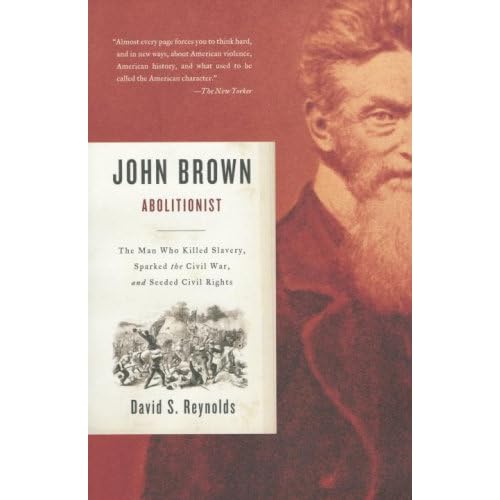
John Brown, Abolitionist by David S. Reynolds


I have started a new nighttime book. I have two books being read at any time, one is serious and usually boring, Zizek’s In Defense of Lost Causes, and then the nighttime book is more fluff. For a long time I have been interested in John Brown and my curiosity has been piqued by its predominance in the new Zizek book. So here I am with John Brown, Abolitionist by David S. Reynolds.

The first nineteen pages are about Brown’s ancestors and a brief (so far it is brief, but still engaged) sketch of Puritanism and abolitionist development. So far the book follows Reynolds’ method of inquiry, but on page 19 he reaches the question of inquiry: “How could Puritanism fuse with antislavery passion with such intensity in John Brown that he believed he could single-handedly free America’s 4 million slaves?’ (19). This is a disappointing question. Has Reynolds forgotten his own discussion about Puritanism?

Puritanism is less about making the world better, although they do strive for it, but more about a complete devotion to an ideal. It is akin to Kant’s categorical imperative, less about the end and more about how to be devoted to the end. (Zizek 2008, 225) If John Brown had been asked this question, I am willing to put money that he was and that the answer is recorded somewhere, I predict his answer would have been quick, short and unwavering: “You tell the one slave I did free that it was all for naught because slavery still exists.”

For another example of this lack of analysis we can look back to page 7.
Although after the raid he was first denounced by most Northerners, a few influential individuals, especially the Transcendentalists, salvaged his reputation by placing him on the level of Christ – a notable misreading of a man who, despite his remarkable virtues, had violent excesses [emphasis mine], as evidenced by the nighttime slaughter of five proslavery residents he had directed in Pottawatomie, Kansas.
I have no problem with Reynolds making a normative assessment of the slaughter, but to call it an excess requires more work. I do hold out the possibility that the work is done later and this reference is merely a foreshadow (page 7, after all), but until I come across that effort I will launch the following criticism. Where is the line demarcating acceptable and unacceptable violence against the slavery advocates? Why should we even care about Reynolds’ theory: Brown believed in a rigorous system of retribution. Were his actions even consistent within his own framework? Or were his actions akin to a violent G8 protest, often conducted by young people merely looking to break stuff.

The book is already predicated upon a belief in comparing alternatives rather than a faith. This cynicism of Reynolds makes me uncomfortable as I wonder about his ability to relate Brown’s thoughts anywhere close to accurately if he cannot even grasp that questions of efficacy were irrelevant to Brown when the matter was one of absolute right and wrong.

Despite this, I find the book engaging and well written. There is more here than I had expected and I am excited to see what else Reynolds will educate me about that I was not expecting.

01 July 2008

On law, Deadwood and Palahniuk

These days I am making my way through season 1 of Deadwood. I am only on episode 5 and I must, literally ‘must’ as I do not want to admit it, say that I am hooked. Ian McShane is marvelous and I think he alone would make the show worthwhile watching. Another thing I really like about the show is its ambition. They speak of the show as depicting (actually, they speak in realist terms as though the show was really Deadwood, South Dakota and not a depiction) a lacuna of Law. The commentary with the show’s creator David Milch, however, shows us that he has a more realistic assessment: the show is not about an absence of Law but rather of the absence of law, attempting to cast the show as a study in other mechanisms of sociality. Too bad the show-sans-commentary does not impart this; the commentary is needed to realize the stated ambition of Deadwood is founded in a hubris.

I finished watching the episode where Jack McCall is tried for Hickcock’s murder and the in-show commentary, delivered by Ian McShane’s character, is wrong. The trial did not mark the introduction of law into Deadwood, precisely because everyone knew the law and civility of the trial was, like its outcome, a sham. What the show did was to show that Deadwood is not a lacuna of the law but that all of the US was lawless. Instead of the law there is only a mask of the law. Zizek sums it up better than I do (keep in mind that Carnivale was another HBO show):

[T]he logic of the social carnival brought to the extreme of self-reflexion: anarchist outbursts are not a transgression of Law and Order; in our societies, anarchism already is in power wearing the mask of Law and Order – our Justice is the travesty of Justice, the spectacle of Law and Order is an obscene carnival (Zizek 2008, 192)


In a strange coincidence (I should not be surprised to find an articulation between Palahniuk and Zizek) I am working on the new Palahniuk book and it is - I am only about a third of the way through the book so this my thoughts may change - also about this mask. At the moment I am meeting the characters as they speak about Cassie. What is interesting is that the characters are in a waiting room bidding time for their chance to be with Cassie, and Palahniuk has yet to introduce me to Cassie. Will he? Is Cassie a transcendental in the book? None of the characters think of her as a transcendental, they all have plans to affect her. But at the same time they all dismiss the others as in-affective, reaffirming her transcendental condition. Does Cassie even exist? Is she instead some mask, some fantasmic inflatable sex doll lifelessly willing to receive their intrusions?

I am not sure where Palahniuk will go with this, but there will be drama and action in the waiting room among the characters, and Cassie, the supposed structuring principle of the story, will be revealed to be an ineffective structuring agent.

30 June 2008

On Violence

“I don’t think it’s out of the question that I would commit physical violence in order to defend my rightful ownership of that console,” Aunt Nina says, suddenly reverting to a kind of dead-voiced frigid calm.
“But that’s not necessary, Nina, because we have created this whole setup here just so that you can give your feelings the full expression they deserve!” Stephenson, Neal. (1999). Cryptonomicon. NY: Harper Perennial. 626)
This passage conjures a few thoughts, none of which are about the suspect nature of an inheritance (the console in question is a piece of furniture Nina’s recently deceased mother owned) as owned property. Instead this passage makes me think of violence and its nature. Nina clearly thinks violence is justified in some, particularly this, instances. Nina’s brother may also share that belief, which is why he created a system to divide the deceased’s possessions as a way to settle disputes without violence. The problem with Nina’s justifications, akin to so many treatises of violence, is their ethics exist in a vacuum. It is easy to say X deserves a violent response but that justification fails to account for other methods of conflict resolution and many times the presence or availability makes the very justification fall short.

This alternative, however, seems to be a double-edged sword. Many times people feel secure and safe because there is a system, even though the system may be seen as bankrupt or ineffective by the soon-to-be-violent. I am not talking here about a revolution, when the alternative is already and clearly indicted by the violent. I am speaking instead about other inter-personal day to day encounters. For example, a friend of a friend, I will call him Pedro, was riding his bicycle home over the bridge by the UMN law school. There were some drunk guys in front of him and these drunkards saw Pedro coming. The bike path on this bridge is narrow, with a concrete wall between it and the car lanes so Pedro had no ability to avoid the drunkards, short of postponing the trip home. One of the drunk men kept moving in front of Pedro chanting “what you gonna do?”

This drunk man clearly thought the system was protecting him, allowing him to be an asshole without consequence – after all, who will respond violently when it is clearly illegal and not worth the assault charge. Pedro asked numerous times for him to move and the man only replied with a slurred, “What you gonna do?” So Pedro punched him; he moved. Pedro rode home.

Was this justified? I contend it was. The alternative (legal system) was absent, in fact it was the potential presence of the alternative which allowed the drunk man to feel secure enough to be an asshole. Pedro was not initially violent, allowing the man opportunities to escape it. All of these circumstances leave me little hesitation in pronouncing his innocence. Would the law find him innocent? Probably not.

29 June 2008

Am I racist?


Am I racist? It seems it would be an easy question to answer. I wish it was. Here is why I wonder: I have an RA working for me this summer that is black and he is lazy. Lazy is such an easy stereotype to (inaccurately) ascribe to a black person – it’s common knowledge, n’est pas? Whenever I think it about him I cringe and wonder if I am being fair. Here is the record:

  • This morning I told him that if any of the campers that had their ID Cards taken from them – punishment for being late to curfew – he should give them their cards, tell them to come down tomorrow morning at 8 AM as they were supposed to do this morning, and then to record their names so I knew whom to expect tomorrow morning. One of the campers came down and he gave the ID card but did neither of the other things.
  • Yesterday a door to the dorm was propped open. This is a huge issue and is to be done only in extreme circumstances. I had only recently propped the door and I knew that he had no knowledge of why it was an extreme circumstance. He walked through the open doorway without any effort being spent to find out if it should have been.
  • He moves so slowly when being waited on. The other day I opened the door for arriving staff – they did not yet have ID cards that granted them access to the dorm – and I saw him so I held the door for him. He definitely saw me and did nothing to accelerate his pace.
  • There are other events from last year which I do not remember specifics of, but I reached the same conclusion last year.

Some may read the above list as proof of a bias and some read it as enough evidence to adequately attach the label – I do have a problem with the notion of lazy, but I will assume here that it is a measurable trait. As to the door issue I can say I saw another RA not long after the black RA make the same error. I do not consider her lazy, not yet anyways, because I have only worked with her a few days now and have not seen a pattern of laziness. Yet, it is the pattern where racism precisely exists.

When is it a pattern? The threshold of discriminating the lazy from the non-lazy is in the measurement of the pattern, with blacks usually being given a lower qualification threshold. This is why I cringe. The above issues are clearly lazy, but is that enough for me to consider him lazy?

25 June 2008

Progress?

The Girl told me a story a few months ago that on one of the first days of Criminal Law there was a discussion of what constitutes rape. The professor grew frustrated because the students were not as talkative as he had hoped. How is this a surprise? Even a volunteer offering a definition of rape is bound to not be inclusive enough for everyone and hence be potentially seen as a misogynist. Zizek offers the lesson to be drawn on page of 50 of In Defense of Lost Causes:

[T]he sign of progress in our societies is that one does not need to argue against rape: it is “dogmatically” clear to everyone that rape is wrong, and we all feel that even arguing against it is too much. If someone were to advocate the legitimacy of rape, it would be a sad sign if one had to argue against him – he should simply appear ridiculous. And the same should hold for torture.


For Zizek the torture comment was not a non-sequitor, you can thank my politics for its inclusion. Anywhoo, I think there is a sophisticated criticism of the way the law applies rape. Rape is not about the relationship of two people compared to a standard rather rape is about the relationship of the two people involved (I recognize that rape can sometimes involve more than two people). William Volmann provides an example of this notion: if on a public bus in Riyadh a man approaches a woman and removes her hijab then that is a form of violence and public humiliation which should be considered a form of rape. Even if it happens in Detroit it ought to be considered a form of rape. Our law, however, is invested with a blind spot. In its efforts to prosecute the worst forms of rape it allows other forms which are deemed by society to be less reprehensible. I am not illusioned to think this is a failure of our legal system, rather it is a problem with law as it is administered by bureaucracies.

The ridiculousness of arguing against rape seems to be almost on par with an event that happened during the Republican Primary debates. Arianna Huffington is correct to say that when five of the candidates raised their hands to say they did not believe in evolution they should have been escorted from the stage and consideration as President. Evolution is not an atheist belief, it is entirely consistent with religion. And there is a wealth of scientific proof of it as a theory to explain variation among species. It is akin to not believing in gravity. I do not want to be all doom and gloom but I find it sad that someone who si so fundamentalist can even gain enough constituents to make a run for the nomination of the incumbent party. My lachrymose mood should not be read as a Democratic rant, rather it should be read as a bipartisan rant about where we are as Americans. Being raised in Texas by a family proud of its country-folk status I am saddened by the theme most unifying of rednecks, a disavowal of education and “high falootin nonsense”. Not that I believe higher education is devoid of nonsense, there is plenty to go around, but an altogether denigration of education seems to be a growing trend. And these are the same people that tend to have the largest families.

24 June 2008

The Reveal

I have always been a proponent of MTV. People mock it, like pop music, but I think there is value to watching it, or at least keeping abreast of it. Not only because I think it is important to be culturally relevant but also because there are important concepts to be gleaned. It may take more work than listening to NPR does, but there is value in there.

I remember a few seasons of The Real World ago there was a marathon with commentary by Coral, a fixture among the franchise. She was commenting on an episode where one of the cast members cheated on a significant other that was back home. Corals’ comment was “and here comes the reveal.” I thought this was particularly insightful since the only thing that was happening was a conversation between the cast member and the significant other, but the name of the other was mentioned. Here is how it usually happens:

Significant other: “What did you do last night?”
Cast member: “Oh, not much. Just hung out with Thomas/Tammy. It was a pretty boring night.”

I thought it was insightful because not only did Coral demonstrate the name dropping was a hint, but that it was an intentional hint – what I guess the kids these days call fishing for a reaction. Zizek (2008) makes the same observation in his latest tome: “the question to be raised is: what more is there hiding in this statement that made the speaker enunciate it?” (49) Zizek and Coral have the same lesson for us: if it was no big deal then why was the name of an-other mentioned? The Real World teaches us that the motivation is to get a reaction. The cast member wants to feel important and the best measure is if you can make another person feel badly by behaving badly.

Zizek’s illustration in In Defense of Lost Causes is eerily similar to the above, a husband and wife in an unspoken open relationship except the husband one day mentions the affair. The wife now responds hysterically because the affair(s) are now spoken therefore something has changed in the relationship.

05 June 2008

James Taylor and melancholy


Here is how I know things are getting better. I am at home, alone watching basketball and reading and not out drinking. The paragon of sadness just came on to sing The National Anthem and my reaction was the once normal grimace. Before this year, and the unfortunate circumstances that befell me I was a happy-go-lucky person. But the past few months were tough and I reveled in those things that are morose, sad and melancholic. Two weeks ago my reaction would not have been a grimace but instead an odd delight.

In case you did not watch the opening ceremonies to-night or have not thought much about classic American singers and sadness then I need to spell it out: James Taylor is the voice of sadness. Nobody is lifted up by his songs. Even if he sings about happy material, it is all sadness. I used to turn him off, but since I turned into a sad person I would listen to his music. But now I cringe. That is a mark of progress.

A few weeks ago I was trying to describe the difference between sadness and melancholy to a friend. James Taylor is an apt example. His music makes me sad. If I turn it off, I do not want to be sad, then that is the opposite of melancholy. If I were melancholy I would instead listen to his music because I want to be sad. Think of Melancholy as the tent where the pity party is held.

So, here we have a legend, admittedly so, of American music that makes people sad. Singing about a war. And this is supposed to be uplifting? I suspect the Celtics’ front office has been paying too much attention to the predictions of a Lakers' championship. And I am still not a basketball fan. But there is so little else on now that Lost has finished.

20 May 2008

Movie: Chronicles of Narnia: Prince Caspian vs. Iron Man

Two lines from The Chronicles of Narnia: Prince Caspian stand out. The first is uttered by Trumpkin, a friendly dwarf, “You may find Narnia a more savage place than you remember,” and a line uttered by Aslan several times, “Things never happen the same way twice.” No doubt this movie is proof. This movie stunk whereas the first installment was thoroughly enjoyable.

A movie populated with children and computer animation is not going to win any acting Oscars. It will not even be considered. The acting reminded me of my summer classes I took when I was in middle school. Those sessions were so bad, including the final production, that I realized (a 12 year old starring in the production realized) acting was not my forte nor could it be. The Narnia players were that unbelievable. I will admit, however, that Iron Man was actually surprising. Who’d have thunk it, that a superhero movie would be marked with good acting. I have always been a Robert Downey, Jr. fan and Iron Man helped solidify his standing. Terrence Howard was even his usual self. And Gwyneth Paltrow actually improved her rankings in my catalogues. And Favreau did a good job with the humor and action in Iron Man.

The Iron Man story was also better. Narnia is clearly informed by a well known Christian writing about Christianity. Even though the movie may try to secularize it (at least somewhat) there is no way to do so. Aslan appears when faith is validated. Aslan has the ability to do anything – the funniest part of the movie was the exchange between Aslan and the mouse voiced by Eddie Izard at the end – such as appear suddenly after a thousand year hiatus, summon the river elemental (?) and regenerate body parts. But the movie in its attempt to distance from the Christian theory actually only epitomizes the most problematic parts of the dogma (if Aslan could have stopped all the bad stuff all along, then why didn’t he?)

Iron Man is almost as problematic. It begins as a polemic about capitalism and its relationship to war and the War on Terrorism. Tony Stark creates an ultimate weapon that can make the war more humane and finished, but it is then co-opted by the terrorists and the capitalists. In the end, the movie makes not an argument against unfettered capitalism but rather makes an argument for war and cleaning up the business of war. But the business of war’s supposed intrinsic goodness remains unquestioned.

There is one thing that needs to be disclosed before I end this post, however. There was a tear-up moment in Narnia and not in Iron Man. At the end when the kids are re-introduced to Aslan there are looks of guilt, as though their wavering faith has hurt Aslan’s feelings and consequently they feel badly for that. Seriously? Aslan was always around, just as God is supposedly always around and yet here we are feeling guilt for not having unwavering belief. Are we truly arrogant enough to think the omnipotent being cares about our faith? The look upon the awakened face would not be one of guilt but rather one of awe. If I were to come face to face with the creator, after so many years of not believing, I would be happy to be home and also terrified for my soul. Guilt for her hurt feelings would not be concern.

Winner: Iron Man.

07 February 2008

RE: KC Keri Oke Lounge

Comment left on a blog: http://kckeriokelounge.blogspot.com/2008/02/meatloaf-with-side-of-really.html

Things about KC I wish someone had told me.

When driving down the highway and you take a particular exit, to turn around or whatnot, it is okay if you end up in a small one lane tunnel with train tracks. It is understandable to be scared but that light you see at the end of the tunnel is not a train barreling towards you. For some reason they made the exit to the trainyard this way and cars are supposed to go down that tunnel. This knowledge will not, however, prevent friends also in the car from either screaming or mocking you later.

KCians take their barbecue seriously. There is a place downtown, Arthur Bryant’s I think, that is supposedly the cat’s meow for barbecue but for us civilized city folk it is disgusting. It is a tiny place that looks filthy on the outside and rest assured it is even grosser inside. Meet hangs on racks in what must be unsanitary conditions. A sandwich will be made in front of you: the cook(?) will grab 2 slices of Wonder, yes Wonder bread, and with a paintbrush apply enough sauce to guarantee the bread is soup by the time it is in your fingers. Large slabs of meat will then be applied.

A friend of mine, a 300 pound New Orleansian that would willingly eat the ass end of a menstruating skunk when hungry, went with me and was as scared for his intestinal track as I was. So, this is not the ranting of some overly-pampered citified version of a dude. I am an overly-pampered citified dude, but I am from Dallas so I am still cool (read: bangable). So my Mom tells me, cool that is. Ewwwwwww. What have I done?

29 March 2007

Michael Crichton is stoopid.

Michael Crichton is an idiot. I listened to a podcast this morning of his participation in a debate about global warming. He stood resolved: global warming is not a crisis. Before hearing this debate I would have greed with the resolution, but not because I deny that anthropocentric warming is occurring but because the impact of said warming is not a crisis.

Crichton, however, had a different argument, one that did not prove the resolution. He argued that poverty kills millions of people a year in preventable deaths and that environmentalists were draining funds from preventing these deaths to some future possible crisis. He then reduced environmentalists to be head-in-the-sand deniers of suffering. This is a weak argument and it exposed Crichton for what I had always feared he was: a moron that can write.

His argument does nothing to the resolution. It addresses neither the impact nor the validity of the global warming debate. The true test is if his opponents, those who argued global warming is a crisis, could agree with his argument that environmental resources could be spent instead on poverty prevention. The answer is yes, and therefore is not in competition with the resolution’s negation.

Leave it to a wealthy person that is not charitable enough to stave off his sense of guilt by blaming the philanthropists of callousness. The environmentalists rallying around global warming are anything but callous moralizers. These are people that see deleterious effects, present or future, caused by our way of living. If anyone is oblivious it would be Crichton for failing to see beyond immediate impacts.

I thought Jurassic Park was an excellent book, one which not only entertained but also sparked scientific interest in non-scientific circles. However, maybe there is a time for Crichton to stop talking in scientific circles and return to what he does best: entertaining the masses.

14 March 2007

Tickner 1994

The masculinity of war depends, therefore, on the myth that women are being protected. Spike Peterson has argued that rethinking the meaning of protection is a crucial component of efforts to address problems of world security. By exposing the protector/protected myth we can deepen our understanding of the real victims of direct violence. The National Organization for Women has estimated that up to 90 percent of total casualties in conflicts since 1945 have been civilians, the majority of them women and children. Moreover, as Judith Stiehm points out, if we are to think of men as protectors we must remember they are usually protecting women from other men.
Feminist theory also draws our attention to the issue of domestic violence, which is prevalent but generally underreported and not legislated against in most societies. By pointing to the high incidence of domestic violence in military families and in militarized societies, feminist perspectives can deepen our understanding of the connection between militarism and sexism. Peterson also asserts that the way notions of protection have traditionally been constructed by the state contributes to the reproduction of hierarchies, including gender hierarchies, and hence to the structural violence against which states say they offer protection. Tickner, Anne. 1994. Peace and world security studies: A curriculum guide. 47-8.


This passage needs little work to serve as an explanation for what is happening in Iraq. While some may see Tickner arguing for a conspiracy against women, I see her argument differently. Women tend to bear the brunt of war because military planners unintentionally overlook some of the horrors of war. The main way this overlooking is done is by the militaries assessments of damage. The military is understandably concerned with attrition rates to enemy combatants and less so to the damage done to noncombatants. I will not say the military is callous, however, as I do think they give some concern to non-combatants, but the damage they measure is the damage done by bombs and ammunition. The damage measured is not the damage caused by, for example, the destruction of a dam and the concomitant loss of running water, electricity and the industries powered by the dam – hospitals, pharmaceutical firms, food preparation firms and other essential firms.

Because the military - even the engaged, shocked and awed military - has rations and drugs, it seems the men of that very military are less affected by the disruptions caused by a war. It is also understandable how a military actuary would overlook the cost of these disruptions, since they are not dependent upon such services in their own respect. For example, when ascertaining the cost of destroying a dam in southern Iraq it is understandable that Captain Moore overlooks some things because those aspects of living are not within his realm of experience. I do not know if Tickner goes so far as to claim all war is bad. If she does then I will diverge from her there, as it seems there are times when maybe things can be improved. The problem though is in those assessments of cost and benefit. If history is indicator though, it seems we as a species need some improvement in our calculations.

We can easily see Tickner’s second paragraph at work in Iraq. The US argument all along was to protect the oppressed in Iraq and to liberate them. That message is now being used against us as the insurgents are targeting civilians. While these civilian killings undermine support for the occupation in Iraq, it also damages US credibility abroad as a capable protection force. The occupation in Iraq has ended up hurting, some would say more than Hussein’s Baath Party, those whose original protection was a justification for invasion.

26 February 2007

Is my girlfriend battered?

I know she is not, but reading a law review article about battered women brought up a recent memory.

Stereotypes and myths exist, such as “Blacks just like to fight”, “Latinas are hot blooded,” and “Asian women are trained for this sort of thing.” These sterotypes and cultural myths serve to place battered women of color in opposition to the image of the white battered woman who is the norm. Morrisson, Adele. 2006, March. Deconstructing the image repertoire of women of color. U.C. Davis Law Review, 39, 1081. 1083.


It is interesting that I should come across after what happened last week. A friend of my girlfriend and I, I will call him Jonah, came back into town and we went out to meet him and my best friend (who introduced us to him). By the time we arrived both of the guys were drunk. Jonah had spent a lot of time with my girlfriend the previous summer when I was out of town for an extended business trip. I knew Jonah had feelings for her, and while we had never talked about it, I knew that she also knew how he felt.

He was drunk and very touchy feely. He had moved away about 7 months ago and it seemed he still liked her. She was uncomfortable but I did not know how uncomfortable, so I did not intervene. Now, she is not known for being tactful when she feels disabused, so I did not think too much about the hanging-on going on. She was being polite and if I saw she wanted me to intervene then I would.

I would also be hesitant to intervene without solicitation because I would worry that I was being the jealous boyfriend. I have always worried that that hesitation would come back to haunt me. At one point the three of them found their way to the bar, as I was talking to an older acquaintance. I guess Jonah started kissing her neck and she was obviously uncomfortable. My best friend intervened; hearing her describe it makes me really proud to be his friend. The situation seemed resolved.

I was finally tired of chasing the drunk boys around, and she needed to wake up early for work the next day, so I decided it was time to leave. Jonah said some things to her that were beyond appropriate, so much so that she did not tell me until we returned home, because while the threshold may be too high I would have acted. But that is irrelevant to the passage above.

My concern is that because my girlfriend is feistier than most, do people that know her not step up to defend her when they should because of her reputation? Discussing it later that night she did say that she feels constrained by her reputation. She worries about even speaking up sometime because she fears being dismissed as being argumentative. I told her to never hesitate when she feels uncomfortable, maybe other times she should be less argumentative, but not in these instances.

As an analogy I worry that I am the criminal justice system by not being responsive enough to her concerns out of concern for the myth of “being hot blooded”. I also have the other hesitation, the concern of being too involved and jealous, but this only compounds my worries. I am thankful that my best friend acted. It sounds like the situation was so over the top that even I would have acted, but I am not so sure. I like to think I would have acted.

22 February 2007

Swivel rocks!


Swivel is a new web site that provides data sets on all kinds of stuff. The site will also run analyses and I am sure things much more complicated than I am able to understand on differing data sets.

I thought this was a funny set. I would like to see this data placed into a time series over the 47 years the data was collected from. I am curious to see how much smaller the more contemporary playmates are than the ones from years past.