Showing posts with label Zizek. Show all posts

07 July 2008

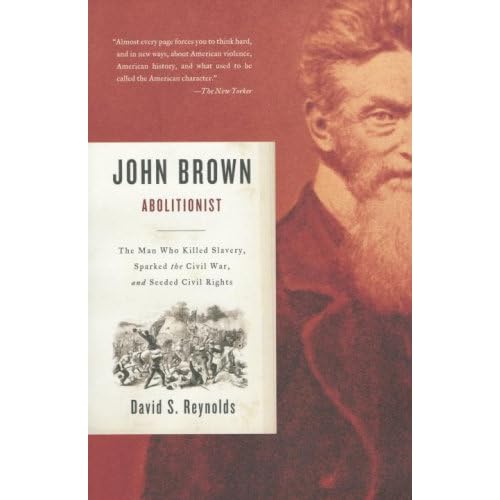
John Brown, Abolitionist by David S. Reynolds


I have started a new nighttime book. I have two books being read at any time, one is serious and usually boring, Zizek’s In Defense of Lost Causes, and then the nighttime book is more fluff. For a long time I have been interested in John Brown and my curiosity has been piqued by its predominance in the new Zizek book. So here I am with John Brown, Abolitionist by David S. Reynolds.

The first nineteen pages are about Brown’s ancestors and a brief (so far it is brief, but still engaged) sketch of Puritanism and abolitionist development. So far the book follows Reynolds’ method of inquiry, but on page 19 he reaches the question of inquiry: “How could Puritanism fuse with antislavery passion with such intensity in John Brown that he believed he could single-handedly free America’s 4 million slaves?’ (19). This is a disappointing question. Has Reynolds forgotten his own discussion about Puritanism?

Puritanism is less about making the world better, although they do strive for it, but more about a complete devotion to an ideal. It is akin to Kant’s categorical imperative, less about the end and more about how to be devoted to the end. (Zizek 2008, 225) If John Brown had been asked this question, I am willing to put money that he was and that the answer is recorded somewhere, I predict his answer would have been quick, short and unwavering: “You tell the one slave I did free that it was all for naught because slavery still exists.”

For another example of this lack of analysis we can look back to page 7.
Although after the raid he was first denounced by most Northerners, a few influential individuals, especially the Transcendentalists, salvaged his reputation by placing him on the level of Christ – a notable misreading of a man who, despite his remarkable virtues, had violent excesses [emphasis mine], as evidenced by the nighttime slaughter of five proslavery residents he had directed in Pottawatomie, Kansas.
I have no problem with Reynolds making a normative assessment of the slaughter, but to call it an excess requires more work. I do hold out the possibility that the work is done later and this reference is merely a foreshadow (page 7, after all), but until I come across that effort I will launch the following criticism. Where is the line demarcating acceptable and unacceptable violence against the slavery advocates? Why should we even care about Reynolds’ theory: Brown believed in a rigorous system of retribution. Were his actions even consistent within his own framework? Or were his actions akin to a violent G8 protest, often conducted by young people merely looking to break stuff.

The book is already predicated upon a belief in comparing alternatives rather than a faith. This cynicism of Reynolds makes me uncomfortable as I wonder about his ability to relate Brown’s thoughts anywhere close to accurately if he cannot even grasp that questions of efficacy were irrelevant to Brown when the matter was one of absolute right and wrong.

Despite this, I find the book engaging and well written. There is more here than I had expected and I am excited to see what else Reynolds will educate me about that I was not expecting.

01 July 2008

On law, Deadwood and Palahniuk

These days I am making my way through season 1 of Deadwood. I am only on episode 5 and I must, literally ‘must’ as I do not want to admit it, say that I am hooked. Ian McShane is marvelous and I think he alone would make the show worthwhile watching. Another thing I really like about the show is its ambition. They speak of the show as depicting (actually, they speak in realist terms as though the show was really Deadwood, South Dakota and not a depiction) a lacuna of Law. The commentary with the show’s creator David Milch, however, shows us that he has a more realistic assessment: the show is not about an absence of Law but rather of the absence of law, attempting to cast the show as a study in other mechanisms of sociality. Too bad the show-sans-commentary does not impart this; the commentary is needed to realize the stated ambition of Deadwood is founded in a hubris.

I finished watching the episode where Jack McCall is tried for Hickcock’s murder and the in-show commentary, delivered by Ian McShane’s character, is wrong. The trial did not mark the introduction of law into Deadwood, precisely because everyone knew the law and civility of the trial was, like its outcome, a sham. What the show did was to show that Deadwood is not a lacuna of the law but that all of the US was lawless. Instead of the law there is only a mask of the law. Zizek sums it up better than I do (keep in mind that Carnivale was another HBO show):

[T]he logic of the social carnival brought to the extreme of self-reflexion: anarchist outbursts are not a transgression of Law and Order; in our societies, anarchism already is in power wearing the mask of Law and Order – our Justice is the travesty of Justice, the spectacle of Law and Order is an obscene carnival (Zizek 2008, 192)


In a strange coincidence (I should not be surprised to find an articulation between Palahniuk and Zizek) I am working on the new Palahniuk book and it is - I am only about a third of the way through the book so this my thoughts may change - also about this mask. At the moment I am meeting the characters as they speak about Cassie. What is interesting is that the characters are in a waiting room bidding time for their chance to be with Cassie, and Palahniuk has yet to introduce me to Cassie. Will he? Is Cassie a transcendental in the book? None of the characters think of her as a transcendental, they all have plans to affect her. But at the same time they all dismiss the others as in-affective, reaffirming her transcendental condition. Does Cassie even exist? Is she instead some mask, some fantasmic inflatable sex doll lifelessly willing to receive their intrusions?

I am not sure where Palahniuk will go with this, but there will be drama and action in the waiting room among the characters, and Cassie, the supposed structuring principle of the story, will be revealed to be an ineffective structuring agent.

25 June 2008

Progress?

The Girl told me a story a few months ago that on one of the first days of Criminal Law there was a discussion of what constitutes rape. The professor grew frustrated because the students were not as talkative as he had hoped. How is this a surprise? Even a volunteer offering a definition of rape is bound to not be inclusive enough for everyone and hence be potentially seen as a misogynist. Zizek offers the lesson to be drawn on page of 50 of In Defense of Lost Causes:

[T]he sign of progress in our societies is that one does not need to argue against rape: it is “dogmatically” clear to everyone that rape is wrong, and we all feel that even arguing against it is too much. If someone were to advocate the legitimacy of rape, it would be a sad sign if one had to argue against him – he should simply appear ridiculous. And the same should hold for torture.


For Zizek the torture comment was not a non-sequitor, you can thank my politics for its inclusion. Anywhoo, I think there is a sophisticated criticism of the way the law applies rape. Rape is not about the relationship of two people compared to a standard rather rape is about the relationship of the two people involved (I recognize that rape can sometimes involve more than two people). William Volmann provides an example of this notion: if on a public bus in Riyadh a man approaches a woman and removes her hijab then that is a form of violence and public humiliation which should be considered a form of rape. Even if it happens in Detroit it ought to be considered a form of rape. Our law, however, is invested with a blind spot. In its efforts to prosecute the worst forms of rape it allows other forms which are deemed by society to be less reprehensible. I am not illusioned to think this is a failure of our legal system, rather it is a problem with law as it is administered by bureaucracies.

The ridiculousness of arguing against rape seems to be almost on par with an event that happened during the Republican Primary debates. Arianna Huffington is correct to say that when five of the candidates raised their hands to say they did not believe in evolution they should have been escorted from the stage and consideration as President. Evolution is not an atheist belief, it is entirely consistent with religion. And there is a wealth of scientific proof of it as a theory to explain variation among species. It is akin to not believing in gravity. I do not want to be all doom and gloom but I find it sad that someone who si so fundamentalist can even gain enough constituents to make a run for the nomination of the incumbent party. My lachrymose mood should not be read as a Democratic rant, rather it should be read as a bipartisan rant about where we are as Americans. Being raised in Texas by a family proud of its country-folk status I am saddened by the theme most unifying of rednecks, a disavowal of education and “high falootin nonsense”. Not that I believe higher education is devoid of nonsense, there is plenty to go around, but an altogether denigration of education seems to be a growing trend. And these are the same people that tend to have the largest families.

24 June 2008

The Reveal

I have always been a proponent of MTV. People mock it, like pop music, but I think there is value to watching it, or at least keeping abreast of it. Not only because I think it is important to be culturally relevant but also because there are important concepts to be gleaned. It may take more work than listening to NPR does, but there is value in there.

I remember a few seasons of The Real World ago there was a marathon with commentary by Coral, a fixture among the franchise. She was commenting on an episode where one of the cast members cheated on a significant other that was back home. Corals’ comment was “and here comes the reveal.” I thought this was particularly insightful since the only thing that was happening was a conversation between the cast member and the significant other, but the name of the other was mentioned. Here is how it usually happens:

Significant other: “What did you do last night?”
Cast member: “Oh, not much. Just hung out with Thomas/Tammy. It was a pretty boring night.”

I thought it was insightful because not only did Coral demonstrate the name dropping was a hint, but that it was an intentional hint – what I guess the kids these days call fishing for a reaction. Zizek (2008) makes the same observation in his latest tome: “the question to be raised is: what more is there hiding in this statement that made the speaker enunciate it?” (49) Zizek and Coral have the same lesson for us: if it was no big deal then why was the name of an-other mentioned? The Real World teaches us that the motivation is to get a reaction. The cast member wants to feel important and the best measure is if you can make another person feel badly by behaving badly.

Zizek’s illustration in In Defense of Lost Causes is eerily similar to the above, a husband and wife in an unspoken open relationship except the husband one day mentions the affair. The wife now responds hysterically because the affair(s) are now spoken therefore something has changed in the relationship.

14 November 2006

Zizek 2003

What, then, does the self-beating in Fight Club stand for? IN a first approach, it is clear that its fundamental stake is to reach out and reestablish the connection with the real Other, that is, to suspend the fundamental abstraction and coldness of the capitalist subjectivity best exemplified by the figure of the lone monadic individual who, alone in front of the PC screen, communicates with the entire world. In contrast to the humanitarian compassion that enables us to retain our distance toward the other, the very violence of the fight signals the abolition of this distance. Although this strategy is risky and ambiguous (it can easily regress into proto-fascist macho logic of violent make bonding), this risk has to be assumed – there is no other direct way out of the closure of the capitalist subjectivity. The first lesson of Fight Club is thus that one cannot pass directly from capitalist to revolutionary subjectivity: the abstraction, the foreclosure of the others, the blindness for the others’ suffering and pain, has first to be broken in a risk-taking gesture of directly reaching toward the suffering other – a gesture that, since it shatters the very kernel of our identity, cannot but appear as extremely violent. However, there is another dimension at work in the self-beating: the subject’s scatological (excremental) identification, which equals adopting the position of the proletarian who has nothing to lose. The pure subject emerges only through this experience of radical self-degradation, when I let/provoke the other to beat the crap out of me, emptying me of all substantial content, of all symbolic support that could confer on me a minimum of dignity. Consequently, when jack beats himself in front of his boss, his message to the boss is: “I know you want to beat me; but, you see, your desire to beat me is also my desire, so, if you were to beat me, you would be fulfilling the role of the servant of my perverse masochist desire. But you are too much of a coward to act out your desire, so I will do it for you – here you have it, what you really wanted. Why are you so embarrassed? Are you not ready to accept it?” Crucial here is the gap between fantasy and reality. The boss, of course, would have never actually beaten up Jack: he was merely fantasizing about doing it, and the painful effect of Jack’s self-beating hinges on the very fact that he stages the content of the secret fantasy his boss would never be able to actualize. (Slavoj Zizek. 2003. The ambiguity of the masochist social link. In Rothenberg, Foster & Zizek, eds. Sic 4: Perversions and the social relation. 112-25. 116-7.)


This passage sums up to me why psychoanalysis is such a fun literature to pursue. It possesses a creative and penetrating gaze into events, with a startling ability to explain what is going on. However, it is a reductionist science (read: too creative) and denies the possibility of many differing interpretations (assuming the main principle of psychoanalysis that intent is not important.)

My reading of the scene Zizek discusses is different and probably more in line with the simpleton’s reading: Jack wants to extort money from his boss and fakes a beating to force his boss to give in to the demand, because the boss’s description of how Jack was beaten up by himself would not be credible to anyone except for Zizek.

Zizek’s reading of the scene, however, attributes the same fantasy to both Jack and the boss – to beat Jack up. This is the psychoanalytic tradition: reducing human desire to a basic immutable truth. While desires fluctuate across situations, there is not an allowance in this dyad for differing desire. There is not account in either the movie nor in Zizek’s re-presentation of the movie of the boss wanting to beat Jack up. This is an asserted desire on Zizek’s part and it is understandable why, if the boss does not share jack’s desire then Zizek’s argument falls apart. The boss is no longer a coward. The boss is no longer demonstrating the gap between fantasy and reality.