The following was written for a different publication previous to Monday's events at the Republican National Convention in St. Paul. Stay tuned for discussions about what happened Monday, what I saw and what it all means.
When discussing the upcoming RNC protests many ask why I am involved when protest will be ineffective. This essay will answer their question without either disputing their measure of effectiveness or of disputing the conditions on the street that may or may not result in a larger anti-capitalist constituency. This essay will elaborate two reasons why the very ‘efficacy question’ is a question of the conservative establishment.
The first argument is about our engagement with the world. Instead of futility as a reason for acquiescence I think futility is precisely why one should act. This ethic is seen elsewhere: the inability to stop murder does not mean a murderer should go unpunished; the inability to stop hunger does not mean bread should be hoarded by the rich; the inability to solve AIDS does not mean the cocktail should not be prescribed. There are successes to be achieved in the face of futility, one just needs to change the benchmark of success. To acquiesce is to slide into an atomistic world of darkness that I do not want to inhabit. My engagement is simple, I want to en-courage others to act against what they see as injustice.
The second reason why the ‘efficacy question’ is the wrong question is because it is shortsighted about the complexities of the world. The question is akin to the debates about who was most valuable to the civil rights gains: Martin Luther King, Jr. or Malcolm X. While there are nuanced counterfactual claims to be made this debate overlooks the necessity of one to the other. MLK needed Malcolm X to make his calls seem reasonable to those at risk of losing power. Malcolm X needed MLK to recruit constituents to the cause, allowing a debate over method to then occur.
The current social justice movements are involved in a similar plight. Radical action at the RNC may be the very public action needed to give Obama support not only for his election but also for a more progressive administration. Radical visibility can recruit people to Obama’s reformist camp by making his position seem more reasonable to those otherwise frightened of liberal causes. While Obama may not be the preferred option of the radicals planning to take to the streets, he represents to most a superior option to McCain. Radicals find Obama’s critical stance towards the current war and military engagement preferable to McCain’s rose-colored optimism about US military and moral superiority. A more progressive approach to health care also makes Obama a more preferable option for most of those considering protesting the RNC. Where MLK may have been a less scary option for white onlookers it was the radical appearance of Malcolm X that made MLK’s demands more palatable. Radicals taking to the street in St. Paul may also make an Obama administration more palatable to those that are scared by his politics and skin color.
RNC radical action may help build Obama’s base, but there is another function, similar to how unions train bosses of a shop, of how our action may help train future leaders. When a shop becomes unionized bosses are more likely to be reflexive about their actions. The presence of a structure to act may deter some actions and make the boss think twice before making some acts. This deterrence need not be limited to policy issues either. A recent issue faced by a shop in the Twin Cities is a boss that responds to employee comments with sarcasm and dismissal. If this shop is successful in unionizing one of the demands will be for the boss to not be flippant when a worker has an issue. Politics works the same way: our action may keep Obama from moving in a more rightward direction once he is inaugurated. Obama will face new challenges in his new job and the presence of a radicalized organized population will help shape his decisions and keep him more honest to a progressive agenda.
Questioning the ability of protests to create immediate measurable change is actually a move to keep people from protesting. This question places the goal so far away that the task seems daunting and too tiring, after all people have lives to live. The approach radicals need to take is to abandon that very landscape and recognize that there are other goals to be gained, goals that may actually be more important than the ones we are told (by those we oppose) to aim for.
Showing posts with label resistance. Show all posts
Showing posts with label resistance. Show all posts
02 September 2008


07 July 2008
John Brown, Abolitionist by David S. Reynolds
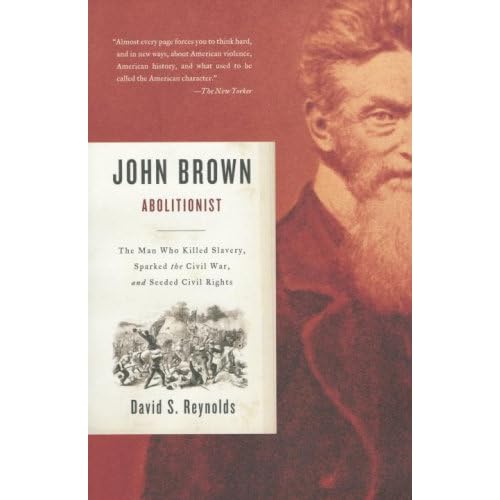
I have started a new nighttime book. I have two books being read at any time, one is serious and usually boring, Zizek’s In Defense of Lost Causes, and then the nighttime book is more fluff. For a long time I have been interested in John Brown and my curiosity has been piqued by its predominance in the new Zizek book. So here I am with John Brown, Abolitionist by David S. Reynolds.
The first nineteen pages are about Brown’s ancestors and a brief (so far it is brief, but still engaged) sketch of Puritanism and abolitionist development. So far the book follows Reynolds’ method of inquiry, but on page 19 he reaches the question of inquiry: “How could Puritanism fuse with antislavery passion with such intensity in John Brown that he believed he could single-handedly free America’s 4 million slaves?’ (19). This is a disappointing question. Has Reynolds forgotten his own discussion about Puritanism?
Puritanism is less about making the world better, although they do strive for it, but more about a complete devotion to an ideal. It is akin to Kant’s categorical imperative, less about the end and more about how to be devoted to the end. (Zizek 2008, 225) If John Brown had been asked this question, I am willing to put money that he was and that the answer is recorded somewhere, I predict his answer would have been quick, short and unwavering: “You tell the one slave I did free that it was all for naught because slavery still exists.”
For another example of this lack of analysis we can look back to page 7.
Although after the raid he was first denounced by most Northerners, a few influential individuals, especially the Transcendentalists, salvaged his reputation by placing him on the level of Christ – a notable misreading of a man who, despite his remarkable virtues, had violent excesses [emphasis mine], as evidenced by the nighttime slaughter of five proslavery residents he had directed in Pottawatomie, Kansas.I have no problem with Reynolds making a normative assessment of the slaughter, but to call it an excess requires more work. I do hold out the possibility that the work is done later and this reference is merely a foreshadow (page 7, after all), but until I come across that effort I will launch the following criticism. Where is the line demarcating acceptable and unacceptable violence against the slavery advocates?
 Why should we even care about Reynolds’ theory: Brown believed in a rigorous system of retribution. Were his actions even consistent within his own framework? Or were his actions akin to a violent G8 protest, often conducted by young people merely looking to break stuff.
The book is already predicated upon a belief in comparing alternatives rather than a faith. This cynicism of Reynolds makes me uncomfortable as I wonder about his ability to relate Brown’s thoughts anywhere close to accurately if he cannot even grasp that questions of efficacy were irrelevant to Brown when the matter was one of absolute right and wrong.
Despite this, I find the book engaging and well written. There is more here than I had expected and I am excited to see what else Reynolds will educate me about that I was not expecting.
05 December 2006
Resistance
There is an old newspaper account of a mass execution in 1922 of some Greek leaders after a failure in a military campaign against Turkey. The Greeks were brought into a courtyard and one of them was very ill, barely able to walk to the execution site. Supposedly, this one man was unable to stand for his execution and despite efforts to stand him up, the executioners decided to shoot him with his head on his knees. This account is somewhat misleading.
People interpret this as the man being very ill, but why is that necessarily the case? Could it also be that the man was resisting. If he is about to be killed, why make it any easier on his executioners? Why allow them to think there is a dignity in the process? Maybe the scene was filled with the dignity of a Picasso, a scene rife with challenges and hegemonic forces encountering their own resistances.
People interpret this as the man being very ill, but why is that necessarily the case? Could it also be that the man was resisting. If he is about to be killed, why make it any easier on his executioners? Why allow them to think there is a dignity in the process? Maybe the scene was filled with the dignity of a Picasso, a scene rife with challenges and hegemonic forces encountering their own resistances.
17 November 2006
Connolly 2002
These are some rough ideas of something I am trying to work out. But given the timliness of Bush's comments to what I am thinking I felt it important to put something out there for some feedback:
The worst thing to happen to the War in Iraq is for Bush to have gone to Vietnam and to see things working well. It has become for him proof about the power of democracy and freedom to prevail in the fight over evil and (Islamic) Fascism. I really these terms are nuanced and not all applicable to past or present Vietnam, but this is how Bush sees the country. There is an obvious reply here, if freedom prevails in Vietnam even though we left it to be under the heel of a communist regime, does that not prove we do not need to be in Iraq to bring them freedom? Possibly, but with Bush in the White House that argument needs not be fleshed out because we will be in Iraq to bring them whatever it is we bring them.
The main problem with the War in Iraq is how US policy is grounded. Clearly there are some issues about planning that need to be examined. But there is something larger at work. The goal that Bush wants has been turned into such a mythic figure of happiness that it now stands as the coercive utopian ideal. These ideals are so powerful that any sacrifice becomes worthwhile and any deviation is seen as the embodiment of evil.
William Connolly discussed this in his book about the effects of St. Augustine. While the passage I am about to re-cite is discussing polytheism as opposed to monotheism, it is applicable as Bush’s war of a value versus the all of the different fanatics and their polyvalent (the individuals may not be fighting for multiple values, but the aggregated enemies of the US are polyvalent). This clash is automatically predisposed to not only resistance but also to a violent response to such resistance.
The worst thing to happen to the War in Iraq is for Bush to have gone to Vietnam and to see things working well. It has become for him proof about the power of democracy and freedom to prevail in the fight over evil and (Islamic) Fascism. I really these terms are nuanced and not all applicable to past or present Vietnam, but this is how Bush sees the country. There is an obvious reply here, if freedom prevails in Vietnam even though we left it to be under the heel of a communist regime, does that not prove we do not need to be in Iraq to bring them freedom? Possibly, but with Bush in the White House that argument needs not be fleshed out because we will be in Iraq to bring them whatever it is we bring them.
The main problem with the War in Iraq is how US policy is grounded. Clearly there are some issues about planning that need to be examined. But there is something larger at work. The goal that Bush wants has been turned into such a mythic figure of happiness that it now stands as the coercive utopian ideal. These ideals are so powerful that any sacrifice becomes worthwhile and any deviation is seen as the embodiment of evil.
William Connolly discussed this in his book about the effects of St. Augustine. While the passage I am about to re-cite is discussing polytheism as opposed to monotheism, it is applicable as Bush’s war of a value versus the all of the different fanatics and their polyvalent (the individuals may not be fighting for multiple values, but the aggregated enemies of the US are polyvalent). This clash is automatically predisposed to not only resistance but also to a violent response to such resistance.
The key defect in the multiple, limited, disputing pagan gods is that they did not have enough power, separately or in combination, to hold out the realistic prospect of eternal salvation to hu8mans, a prospect “which is the essential aim in religion.” Augustine endows his god with omnipotence to enable it to deliver on the promise of salvation. He endows it with care for humanity to make it want to do so. When these three demands are combined (omnipotence, care and salvation), you generate a god who must be the author of an intrinsic moral order and you have a moral order under powerful pressure to constitute itself restrictively and coercively. (The Augustinian imperative. NY: Rowan & Littlefield Publishers, Inc. p. 48-9).
07 November 2006
Tatchell 1997
To-day’s passage from the backfiles is one of the better arguments I have stumbled across in quite some time. Not only is a well-structured argument, but also I find the writing to be good: it is concise and yet the language is not too lofty and obscure. Peter Tatchell is a British human rights activist and I am also assuming he is gay, proud and pissed off. After reading this passage his anger seems not only understandable but also justified, I especially liked the portion that talks about how our society does not protect queers:
The problem I have with this argument is its reductionism. Tatchell seems to believe homosexuals are fundamentally democratic and neither bullies nor aggressive. The military, in his world, is only used to repress progressive movements. These reductions place the military/homosexual pair as automatically opposed and impossible to coexist. I contend, however, that they are opposed in their manifestation and not in some basic kernel of their selves. Everything he says may be accurate, but that does not mean the military must be used to quash progressive movements. Was the Taliban a progressive movement? While there are some problems surrounding the crushing of the Taliban, the quashing of a movement concerned with social justice is not be one of them.
I am also curious how people in the Netherlands would view this passage since the military there allows homosexuals to serve openly. This passage seems uniquely British. An indictment of the British state, even though Tatchell attributes it to the State fundamentally, would be read differently in a different country.
I am also concerned that the bodies in Tatchell’s argument are not marked. I was told in graduate school to do the following test: whenever an unmarked body is presented (in this case the soldier and also the civilian) I should assume the body is white. Do bodies of color change the calculus of this passage? Tatchell would probably argue that does not change his call to resistance. That is the very functioning of whiteness. The military may provide a way out of certain situations, a liberatory way out. Michael Moore highlights the US military recruiting methods, targeting black neighborhoods, but we have to ask why do so many black people sign up? Even though it pains us to point out the truth (the real reason John Kerry came under such scrutiny) it is still the truth: the military can provide a better life for people on the margins of our society. Tatchell does not address these people. He has an interpretation, one which is valid, but there are other interpretations. It this essentializing of reading the military that is the problem in Tatchell’s argument.
Such a statement sums up the way the just demand for an end to homophobic discrimination by the armed forces increasingly has become an unjustifiable endorsement of militarism and war. The experience of being marginalized by society as “abnormal” and “deviant” ought to give us queers a more critical attitude towards all social institutions, including the military. Instead of blithely assuming that everything straight is wonderful, we should have a healthy skepticism towards straight culture. No hetero institution is more deserving of our skepticism than the armed forces. It denies democratic rights to its own members, tolerates bullying, lacks mechanisms for public scrutiny and accountability, discriminates against lesbians and gay men (and women and black people), and has a been used frequently to suppress popular movements for social justice and national liberation in countries like Malaya, Kenya, Cyprus, Aden and Ireland. Above all else, the military is a straight institution. It is organized and dominated by the hetero majority. Part of the function of the military is the defence of a society ruled by straights (as well as big business). It serves straight interests and upholds the macho straight values of violence and homophobia. Everything about the military is inimical to queer freedom: hierarchy, domination, prejudice, aggression, conformity and authoritarianism. Moreover, the military is an instrument of State power. The State is homophobic, enforcing legal discrimination against lesbian and gay people. As a part of the repressive apparatus of the State, the armed forces embody this anti-gay discrimination, banning queers from joining the military and forcing out those it discovers within its ranks. In defending the State, the military also implicitly defends the anti-queer repression of the State, including the unequal age of consent, the arrest of gay men for victimless cruising, the ban on the promotion of homosexuality by local authorities, the denial of legal recognition to queer partnerships, and the lack of redress against homophobic discrimination in housing and employment. Lesbians and gay men have a right, and even a responsibility, to refuse allegiance to a homophobic government and its homophobic military apparatus. Faced with unjust laws that discriminate against homosexuals, queers are duty-bound to deny legitimacy to the straight governing elite and to withdraw all consent and co-operation from governmental institutions such as armed forces. According to liberal theory, rights carry with them responsibilities. But in the absence of civil and human rights, the duty of reciprocal responsibilities ceases to exist. This means that we queers are under no obligation to join the military to protect those who refuse to protect us. Instead, there is an onus on us to withhold our loyalty from the institutions of a homophobic State, such as the armed forces, and to do everything in our power to sabotage the straight system which treats us as second class citizens. You don’t have to be a queer revolutionary to realize this, just a homo with a bit of common sense and self-respect. The idea of queer non-compliance with homophobic institutions like the military is rooted in the civil disobedience tradition of Mahatma Gandhi and Martin Luther King. They argued: unjust laws must be broken, not obeyed. When governments deny human rights, those excluded from full citizenship have a moral right to rebel against tyrannical rulers. These principles are just as relevant for lesbians and gay men today as in Britain as they were in the past for the Indian independence movement and the US black civil rights struggle. The armed forces do not respect gay rights. Why, then, should we enlist and serve? Is there any reason for queers to give a damn about the fate of the straight State? We homos (and our straight allies) have no obligation to defend the fraudulent democratic system that denies us equality. On the contrary, the queer self-defence requires that we subvert and destroy the hetero institutions that hold us down. Collusion with a homophobic State and a homophobic military is collusion with anti-gay discrimination. To do the bidding of those who victimize us betrays the cause of queer freedom. That’s why all queers everywhere have a responsibility to refuse collaboration with the oppressive military system. By so doing, we can help strike a blow for lesbian and gay emancipation, and against oppressive militarism and war. (1997, Why we shouldn’t’ march straight. Queer Words, issue 3)
The problem I have with this argument is its reductionism. Tatchell seems to believe homosexuals are fundamentally democratic and neither bullies nor aggressive. The military, in his world, is only used to repress progressive movements. These reductions place the military/homosexual pair as automatically opposed and impossible to coexist. I contend, however, that they are opposed in their manifestation and not in some basic kernel of their selves. Everything he says may be accurate, but that does not mean the military must be used to quash progressive movements. Was the Taliban a progressive movement? While there are some problems surrounding the crushing of the Taliban, the quashing of a movement concerned with social justice is not be one of them.
I am also curious how people in the Netherlands would view this passage since the military there allows homosexuals to serve openly. This passage seems uniquely British. An indictment of the British state, even though Tatchell attributes it to the State fundamentally, would be read differently in a different country.
I am also concerned that the bodies in Tatchell’s argument are not marked. I was told in graduate school to do the following test: whenever an unmarked body is presented (in this case the soldier and also the civilian) I should assume the body is white. Do bodies of color change the calculus of this passage? Tatchell would probably argue that does not change his call to resistance. That is the very functioning of whiteness. The military may provide a way out of certain situations, a liberatory way out. Michael Moore highlights the US military recruiting methods, targeting black neighborhoods, but we have to ask why do so many black people sign up? Even though it pains us to point out the truth (the real reason John Kerry came under such scrutiny) it is still the truth: the military can provide a better life for people on the margins of our society. Tatchell does not address these people. He has an interpretation, one which is valid, but there are other interpretations. It this essentializing of reading the military that is the problem in Tatchell’s argument.
Subscribe to:
Posts (Atom)
